A curated companion to your AI Coordinator course — the frameworks and models we worked with for identifying and prioritising AI use cases, plus key standards and further reading. This page is updated continuously, so bookmark it and check back.
AI Strategist & AI Product Manager · Munich, Germany
Experienced AI Strategist & Product Manager with a deep understanding of the transformation of business models and business processes through artificial intelligence. Since 2015, I have supported companies from the initial brainstorming stage through prototyping to the scaling of AI products. I bridge the gap between business, technology and user experience. On behalf of TÜV SÜD, I train and certify AI Coordinators, AI Officers and Chief AI Officers worldwide in companies of all sizes.
Over 20 years of professional experience — initially as Head of Digital at IBM, then (2015–2021) as Head of Data & AI at IBM, and since 2022 as an independent AI consultant developing and implementing AI-supported solutions for enterprises and SMEs.
Product management for AI features
From idea to MVP to scale-up — accompanied several successful AI product launches.
Strategy consulting & workshops
Facilitation of AI strategy workshops for C-level and product teams across various industries.
02Strategic Framework
Identifying AI Use Cases in Organisations
Successfully implementing AI in enterprise settings requires a disciplined, collaborative approach that balances strategic vision with operational realities. Organisations that follow a structured process can systematically identify and prioritise AI opportunities that deliver tangible business value and competitive advantage.
01
Align with Strategic Priorities
Map AI opportunities to your company's key business goals and challenges over the next 3–5 years. Focus on areas with the highest potential ROI and strategic impact to ensure stakeholder buy-in and resource optimisation.
02
Engage Cross-Functional Teams
Involve employees from diverse departments through workshops, hackathons and surveys to crowdsource AI use case ideas grounded in real operational pain points and user needs.
03
Analyse Business Processes & Data
Conduct thorough reviews of workflows to identify inefficiencies, bottlenecks and repetitive tasks where AI can add value. Leverage data experts to uncover patterns and validate data readiness.
04
Prioritise by Value and Feasibility
Evaluate potential AI projects based on measurable business impact, implementation complexity, data availability and technology maturity. Use a structured scoring framework to rank opportunities.
05
Start Small, Scale Fast
Focus initially on "super-assistant" AI applications that augment employee productivity and decision-making. Early wins build momentum for broader AI adoption across the organisation.
06
Foster Leadership Support
Ensure executive sponsorship to drive AI initiatives and cultivate a culture of experimentation, learning and continuous improvement throughout your organisation.
Key Takeaway
The most successful AI transformations begin with a clear understanding of business objectives, involve stakeholders across the organisation, and prioritise use cases that deliver measurable impact while building organisational capability and confidence.
03Transformation Lens
Operating vs. Business Model
AI initiatives can yield value by optimising internal operations or by fundamentally transforming market offerings. Understanding these two dimensions is crucial for strategic prioritisation.
Operating Model Enhancements
Run the business better
Focuses on driving efficiency, reducing costs and expanding profit margins within existing business processes.
Automate routine administrative tasks
Optimise supply chain and logistics
Enhance back-office process efficiency
Business Model Innovation
Change the business
Aims to create new revenue streams, disrupt markets and introduce innovative products or services.
Develop personalised customer experiences
Offer predictive maintenance as a service
Enable data-driven new product development
Key methods for use case discovery
1
Data-Driven Exploration
Assess available and obtainable data to identify where AI can unlock new insights or automate decision-making processes.
2
Complex vs. Simple Process Analysis
Deconstruct workflows to pinpoint inefficiencies and prioritise smaller, impactful sub-processes for intelligent automation.
3
Bottom-Up Experimentation
Empower employees with AI tools and foster a culture of experimentation, supported by a structured use case reporting framework.
4
Hybrid Approach
Combine leadership guidance on strategic AI objectives with employee-driven discovery of specific solutions and tool implementation.
04Discovery & Delivery
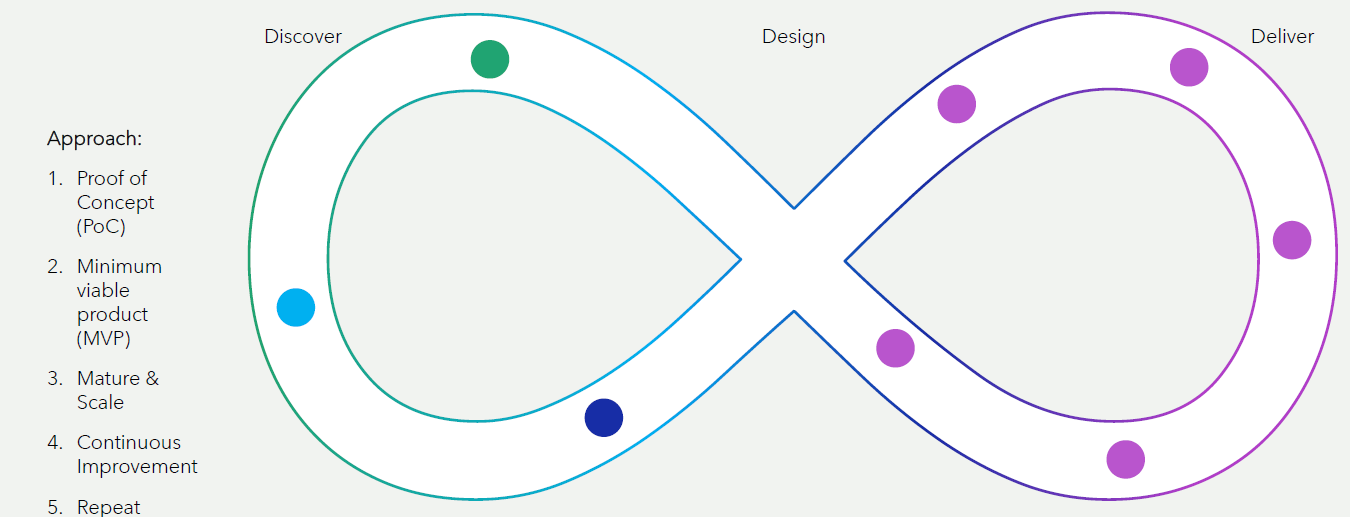
Our Process — the Discovery Loop
A continuous discovery-and-delivery cycle: we discover real user needs, design the right solution, and deliver it iteratively — then loop again. It is never a one-off project.
Our process · Discover → Design → Deliver · a continuous loop, not a one-off project
Empathize
Gain an understanding of the users' needs, thoughts, emotions and motivations.
Define
Define the users' needs and frustrations based on the insights gained.
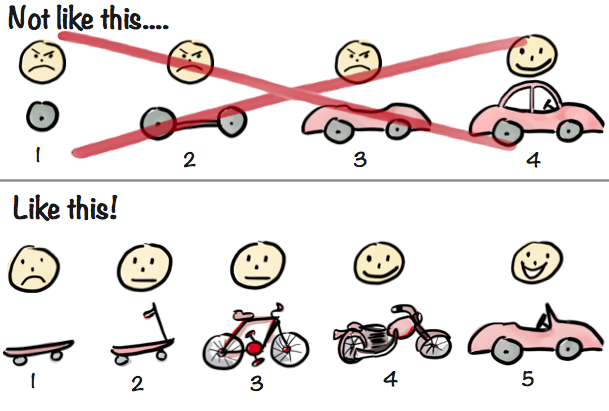
Following the maturity path above (PoC → MVP → Mature & Scale), the point of a Minimum Viable Product is not a half-finished version of the final product, but the smallest thing that already delivers value and lets you learn from real users. Henrik Kniberg's classic sketch captures the difference perfectly.
A continuously updated, searchable collection of real-world AI incidents and harms — an excellent source for risk identification workshops, awareness sessions and lessons learned.
The most critical security risks for applications built on large language models and generative AI — from prompt injection and sensitive-information disclosure to excessive agency. A practical checklist when reviewing or commissioning GenAI solutions.
A free interactive tool from TÜV SÜD that helps you classify an AI system under the EU AI Act — prohibited, high-risk, limited or minimal risk — and understand the resulting obligations. Ideal for a first risk triage of your own use cases.
The key international standards behind trustworthy AI — terminology, management systems, risk assessment, data quality, and the upcoming European QMS standard for the EU AI Act.
AI Coordinator is your Level 1 foundation. The natural next step is the AI Officer certification at the TÜV SÜD Academy, where you go deeper into AI governance, the EU AI Act, organisational readiness and operating an AI management system.
In this training we explored how you can identify and evaluate AI application opportunities and risks within corporate organisations. The real value emerges when you translate these insights into your specific context.
One-on-one implementation call
I'd like to offer you a personal conversation to explore:
How the concepts we discussed apply to your particular situation
Practical steps for implementation within your organisation
How to address potential challenges you might face
You'll also receive tailored templates and resources that support this transition. To schedule, send an email with 2–3 suggested time slots within the next few days and I will send you an invitation.